
Mosaic / Mosaïque / Mozaik
Norman McLaren, Evelyn Lambart (National Film Board of Canada)
1965, Canada 5’41”
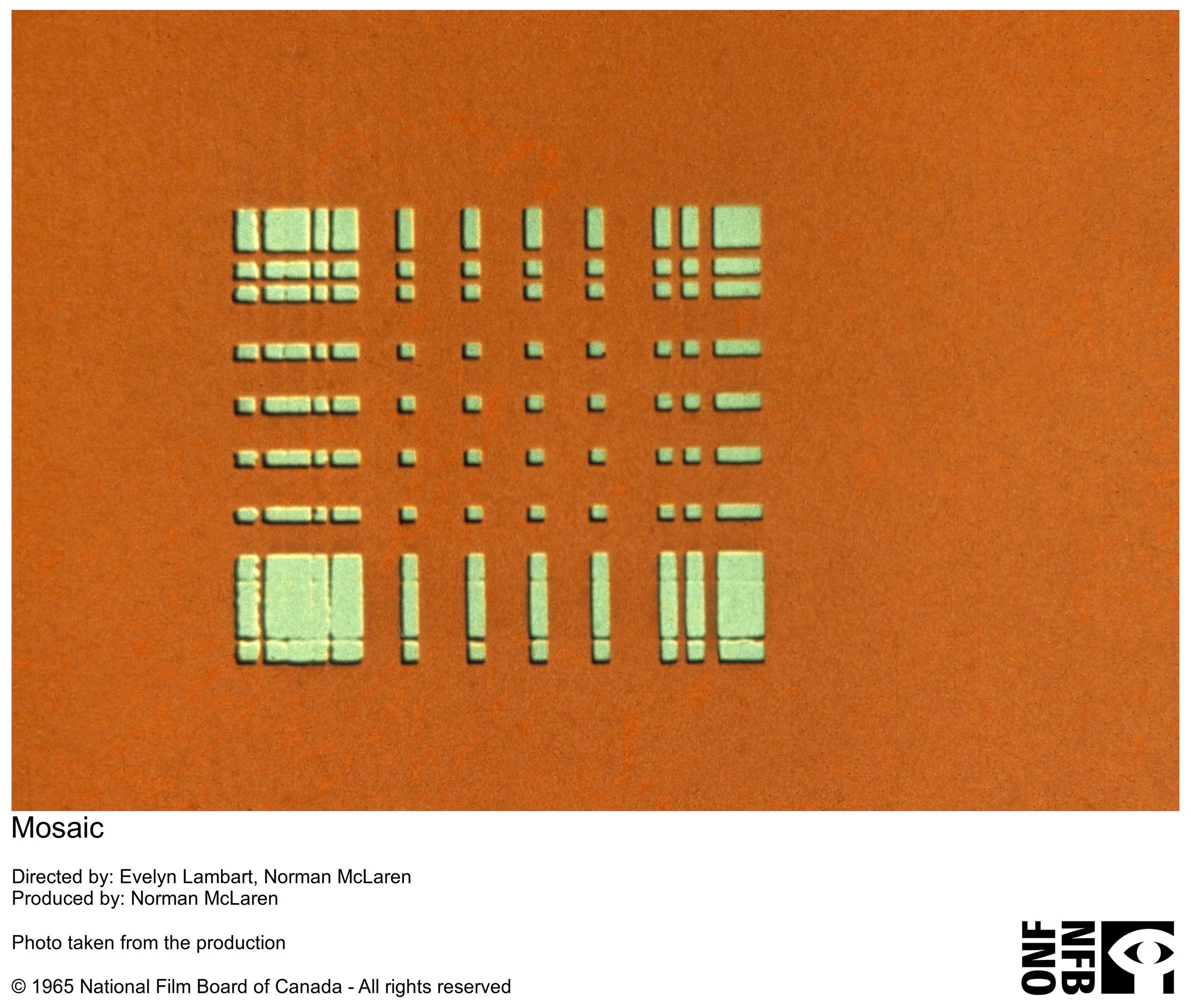
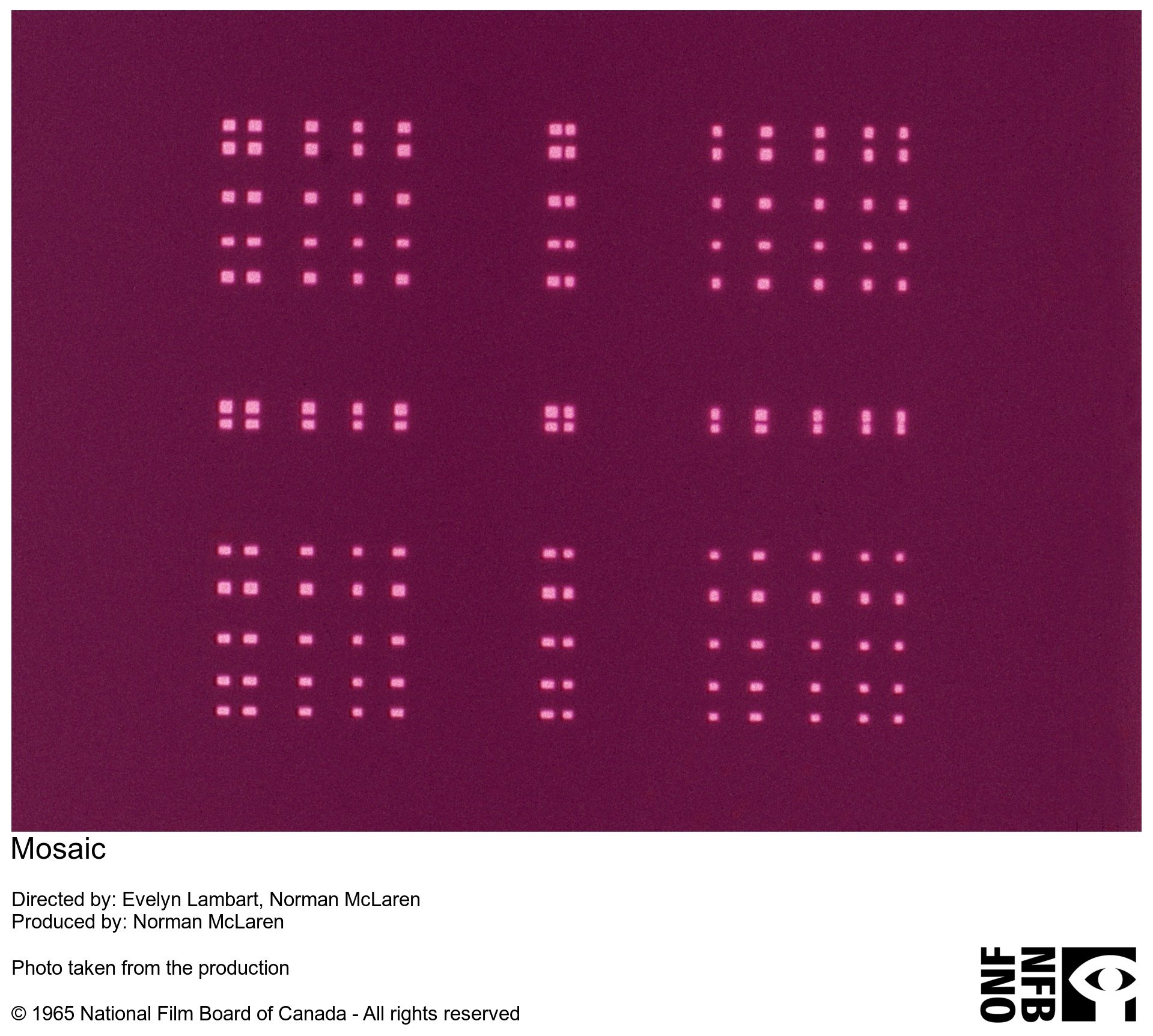
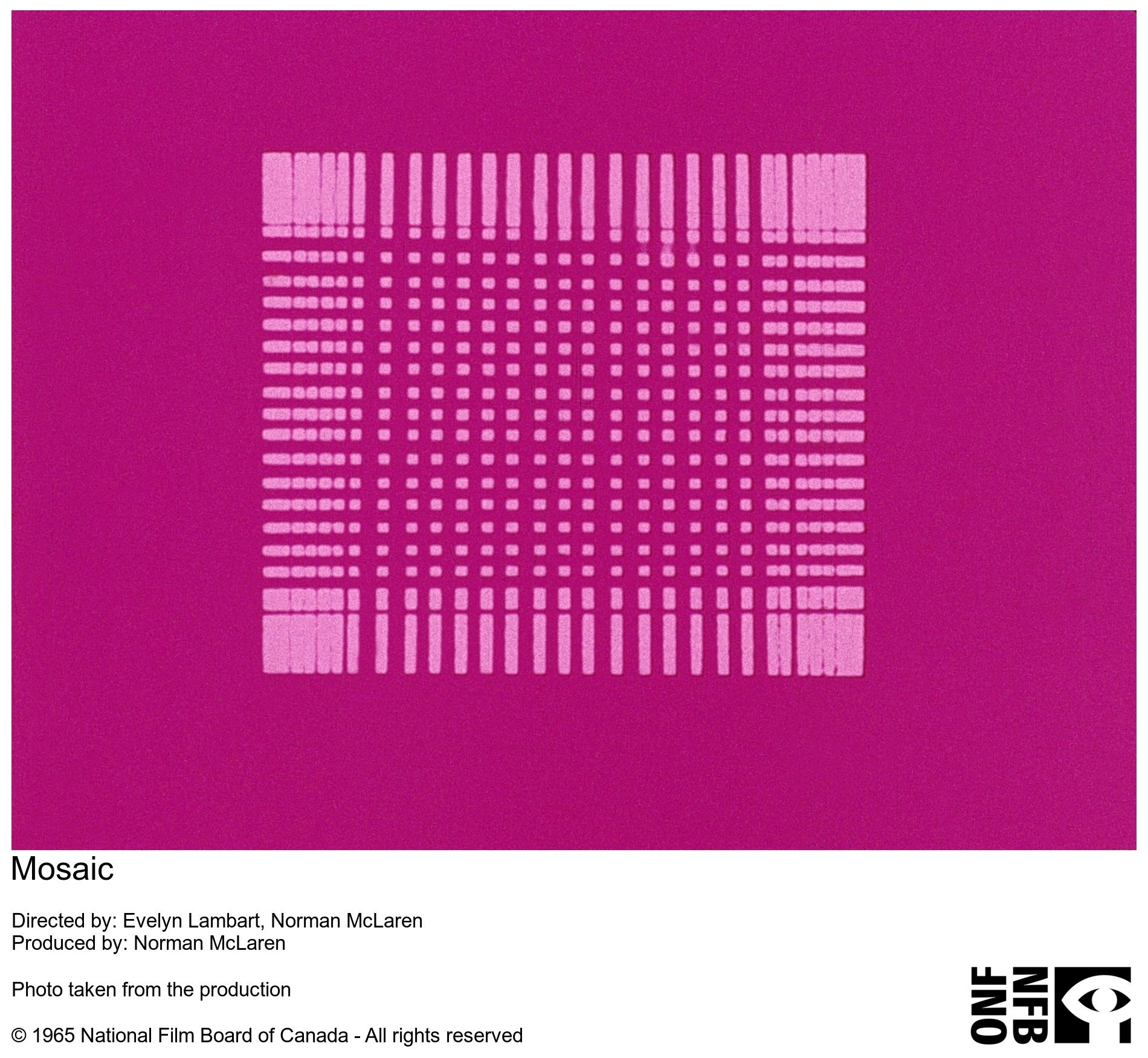
Tempting the eye with gradually unfolding yet increasingly complex movement, colour and sound. Reminiscent of the mid-20th-century style of op art, the film follows a single tiny square as it divides and multiplies, eventually forming a colourful, hypnotic mosaic set to the animators’ precise and deliberate musical orchestration.
Film pritegne oko s postopoma razkrivajočim se, a vse kompleksnejšim gibanjem, barvo in zvokom. V slogu oparta s sredine 20. stoletja sledi enemu samemu drobnemu kvadratku, ki se deli in množi ter na koncu ustvari barvit, hipnotičen mozaik ob spremljavi natančne in premišljene glasbene orkestracije obeh animatorjev.
-
The film is based on Lambart and McLaren’s Lines-Vertical (1960), made by engraving straight lines on black leader, and Lines-Horizontal (1962), created by optically turning the former image 90 degrees. Their images were combined in an optical printer to create the negative for Mosaic, with clear dots at the intersections. Colour was added through filters and coloured celluloid, and the soundtrack was engraved directly onto 35 mm black film stock. See more: Technical Notes by Norman McLaren (1933-1984), 2006.
-
Tehnični vidiki: Film temelji na delu Lines-Vertical (1960) Lambartove in McLarena, ki je nastal z vrezovanjem ravnih črt v črni vodilni filmski trak, in na Lines-Horizontal (1962), ustvarjenem z optičnim zasukom prve slike za 90 stopinj. Njune podobe so bile združene v optičnem kopirnem stroju, s čimer je nastal negativ za Mozaik s prozornimi pikami na presečiščih črt. Barva je bila dodana s pomočjo filtrov in barvnega celuloida, zvočni zapis pa je bil vrezan neposredno na 35-milimetrski črni filmski trak. Več: Technical Notes by Norman McLaren (1933–1984), 2006.
Language: None
Technique: Direct animation
Recommended for children under 14 years of age: Yes
Team
Directed and animated by Norman McLaren and Evelyn Lambart
Music: Norman McLaren
Sound: Ron Alexander
Producer: Norman McLaren

Norman McLaren
(1914-1984): The young Norman McLaren began his filmmaking career in 1934, and the following year, two of his films won prizes at the Scottish Amateur Film Festival, where John Grierson offered him a job at the General Post Office Film Unit in London. In 1941, at the invitation of Grierson, who had become Canada’s first Government Film Commissioner, McLaren joined the National Film Board. The first films he made for the NFB were almost all intended to support the war effort. This didn’t prevent him from making several experimental films and founding an animation department. Over the course of his career, he mostly created experimental animation, with music as an important element. He also experimented with the use of dance and dancers. McLaren’s films have garnered more than 200 awards. “Neighbours” won an Oscar in 1952, and “Blinkity Blank” received the Palme d’Or for short films at the 1955 Cannes festival. In 2009, “Neighbours” was added to the UNESCO Memory of the World Register, which lists the most significant documentary heritage collections. McLaren was a master and a source of inspiration for countless filmmakers, and audiences around the world consider his name to be practically synonymous with the NFB.
Find more: www.nfb.ca/directors/norman-mclaren , "Creative Proces: Norman McLaren", 1990, dir. Donald McWilliams, www.nfb.ca/film/creative_process_norman_mclaren
Evelyn Lambart
(1914-1999): a Ontario College of Art in 1937, she became the first woman animator to join the National Film Board of Canada in 1942. She was a significant and influential co-creator of many films with Norman McLaren, among them “Begone Dull Care” (1949), “Around Is Around” (1951), “Now Is The Time” (1951), “A Chairy Tale” (1957), “Lines-Vertical” (1960), “Lines-Horizontal” (1962), “Mosaic” (1965). In her individual works she mastered paper cut-out animation with bright colours, e.g. “Fine Feather” (1968), “Paradise Lost” (1970), “Mr. Frog Went to A-Courting” (1974), “The Lion and the Mouse” (1976).
Find more: www.thecanadianencyclopedia.ca/en/article/evelyn-lambart