WORKSHOT 2.0: DEAD MEDIA
17. - 27. 9. 2026, Zoom, Vetrinj mansion, Maribor Puppet Theatre
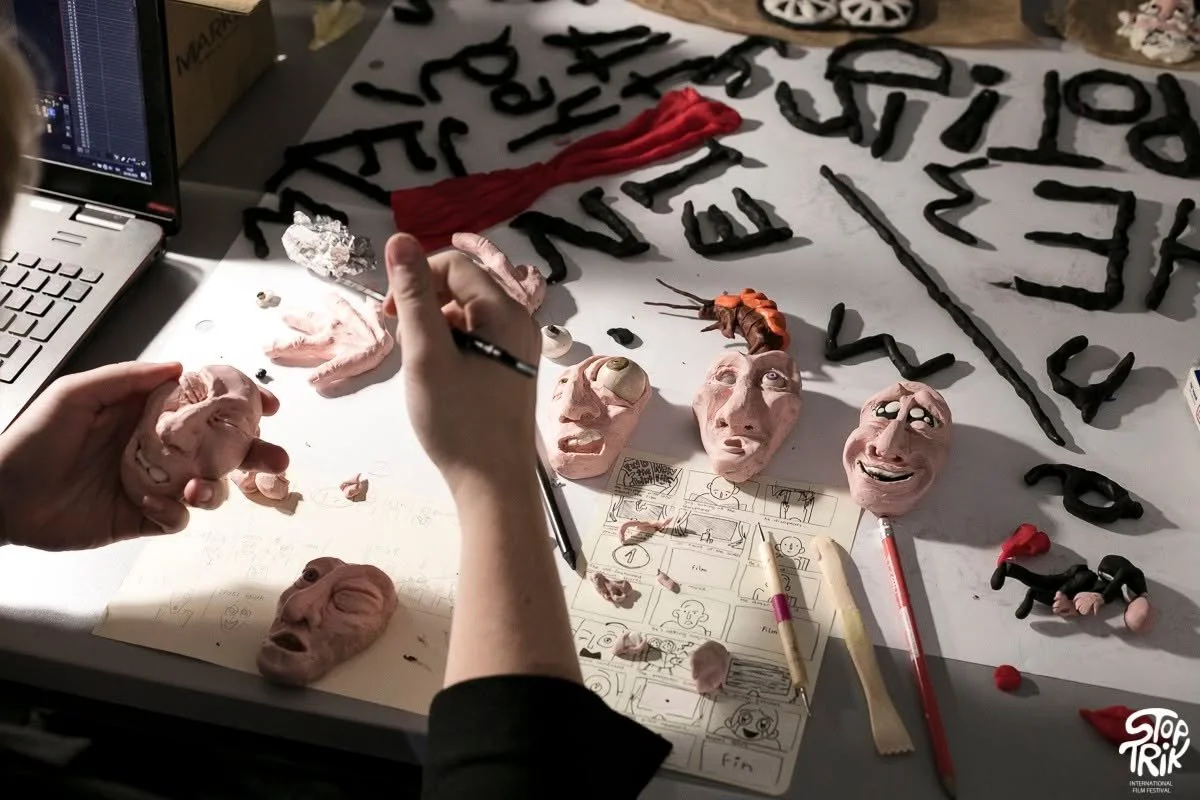
THREE-PHASE WORKSHOP of concept-based animation filmmaking where practical execution of your short animated group project concludes the process of learning critical approaches to media and understanding film as a complex mode of artistic communication.
This workshop is designed as a guided journey through following stages of the creative practice: (1) CRITICAL LITERACY – diagnosing problems, understanding means and methods of communication, (2) NARRATIVE-BUILDING – finding a story and its right tempo within yourself, your memories, or your surroundings, constructing it accordingly to animation medium capacities; (3) ANIMATION – experimenting with scratching on photographic materials and other images on your own terms
The participants will have a chance to learn original scratching on images and other hands-on techniques from MOÏA JOBIN-PARÉ (Canada), a multidisciplinary artist interested in exploring what’s beyond reality (assisted by BRINA FEKONJA and LENE LEKŠE); narrative-building from MAX HATTLER (Germany / Hong Kong), a multi-awarded artist and researcher working at the intersections of digital tools and historical media techniques; the skills of critical literacy will be introduced by the social activists URŠKA BREZNIK and KAJA FIEDLER (Slovenia); sound design aid will be provided by MIHA ŠAJINA (Slovenia).
WHY WOULD YOU DO THIS?
16th StopTrik IFF invites you to dive into the questions of what it means and how it happens that media die – when and how new media become traditional, obsolete, forgotten – dead? Do they disappear or do they reincarnate? Can you summon their ghosts? Should some media go to hell? In 1995 Bruce Sterling said that some media, which originated from human curiosity, creativity, and the need to play with illusions, phantoms, or even simple toys, they “died on a barbed wire of technological advance”. Another great media scholar, Henry Jenkins, polemicized in 2006. He noted: “Yet, history teaches us that old media never die – and they don’t even necessarily fade away. What does die are simply the tools that we use to access media content (…) Recorded sound is the medium. CDs, MP3 files, and 8-track cassettes are delivery technologies.” And where do you stand in this discussion? Are you nostalgic for the “forgotten media” or excited just by the thought that they can be reconfigured to suit the needs of contemporary artistic experiences and entertainment? At this workshop you are free to shape your own meanings through handcraft that makes the materiality disintegrate before your eyes.
WORKSHOP STRUCTURE: TIME & CONTENT
Phase 1: Critical Literacy workshop with Urška Breznik and Kaja Fiedler
17. 9. 2026, Zoom
During this phase the participants will learn about:
• Power relations in society and the ways to analyze them;
• How accessing knowledge and information is related to power;
• How to apply critical discourse analysis to written, visual and audiovisual texts.
Phase 2: Building the Narrative: Dead Media, Found Images and Experimental Dramaturgy, narrative-building workshop with Max Hattler
20. - 22. 9. 2026, Vetrinj mansion
During this phase the participants will learn how to:
Develop an experimental understanding of narrative as visual progression, rhythm, transformation, and association);
Explore found, archival, photographic, and obsolete media materials as prompts for collective moving image work;
Create a concise, achievable group outcome, such as a visual score, storyboard, non-linear edit, or draft animatic, to guide the animation phase.
Phase 3: Hands-on animation workshop with Moïa Jobin-Paré
23. - 27. 9. 2026, Maribor Puppet Theatre
During this phase the participants will learn to:
Explore different ways of modifying and connecting printed images using hands-on techniques such as scratching photographs and cut-out animation;
Discover how layering, moving, removing, duplicating, altering, and even destroying printed images can become part of a creative process;
Reanimate still and pre-existing images of various types, qualities, formats and eras.
ABOUT MENTORS AND ASSISTANTS:
Urška Breznik is a Sinologist and art historian, director of Pekarna Magdalenske mreže since 2013. She coordinates projects in the field of youth and cultural and develops and leads critical literacy workshops and seminars for young people, youth and pedagogical workers and general public. Executive producer of StopTrik IFF.
Kaja Fiedler is a Sociologist employed at Pekarna Magdalenske mreže since 2016. Developing and leading critical literacy workshops and seminars for young people, youth and pedagogical workers and general public. Coordinating educational projects in the field of housing cooperatives, climate crisis and workers’ rights. Producer of music events at StopTrik IFF and editor of StopTrik IFF website and social networks.
Max Hattler, an artist, animator, and researcher whose work explores abstract and experimental forms of audiovisual practice. His films and installations have screened and received awards at festivals worldwide. He is a tenured Associate Professor at the City University of Hong Kong and the founder of the Relentless Melt screening series for experimental animation. Hattler’s research focuses on visual music, optical sound, and the intersections of digital tools with historical media techniques. As a practitioner-researcher, he combines hands-on production with theoretical and historical inquiry, investigating how abstract imagery and parametric animation can generate and structure audio-visual experiences in contemporary moving-image culture.
Moïa Jobin-Paré, a filmmaker working at the intersection of animation and photography, Moïa Jobin-Paré has, since 2015, developed a multidisciplinary practice dedicated to contemporary imagery and its hybrid forms, bringing together her major passions: moving images, painting, material and digital practices, and sound. She has developed a unique and innovative technique of scratching on photographic film, which she has presented in exhibitions and used to create short films. Born in 1978, she grew up both in the countryside and in the city. She lives and works in Montreal.
Brina Fekonja has a BA in industrial design from the Academy of Fine Arts and Design, University of Ljubljana, and is currently pursuing a master’s degree in Media Arts and Practices – Animation at the School of Arts, University of Nova Gorica. Fekonja is interested in (stop-motion) animation, teaching, design, photography, film, nature, society and the notion of common/community. Since 2015, she has been part of the team behind the StopTrik International Film Festival (coordinator and selector of children’s programmes).
Lene Lekše (b. 1995) is a Slovenian multidisciplinary artist blending sculpture, animation and pedagogy. A graduate of Ljubljana's Academy of Fine Arts, she collaborates with SLON collective and coordinates workshops for Animateka Festival. Her work explores material transformations through stop-motion, while her educational programs bridge contemporary art and animation for young creators.
Miha Šajina is a Slovenian composer, producer and electronic musician known for his modular synth experiments. A former member of the bands EWOK and Moveknowledgement, he now scores animated films and leads sound workshops, merging DIY electronics with visual media. His work explores the intersection of abstract soundscapes and narrative animation.


WORKSHOT 2.0: DEAD MEDIA is a project organised by Pekarna Magdalenske mreže through cooperation with a network of universities collaborating in the framework of the BIP ERASMUS NETWORK, coordinated by the University of Nova Gorica School of Arts (Slovenia), and involving the following partners: University of Applied Sciences Upper Austria (Wels, Austria); NBU New Bulgarian University in Sofia (Bulgaria); Academy of Fine Arts in Zagreb (Croatia); EKA Estonian Academy of Arts in Tallinn (Estonia); Universidade Lusófona de Lisboa (Portugal); Academy of Performing Arts VŠMU (Bratislava, Slovakia), and Szczecin Art Academy (Szczecin, Poland), The Academy of Arts of the University of Banja Luka (Bosnia and Herzegovina).